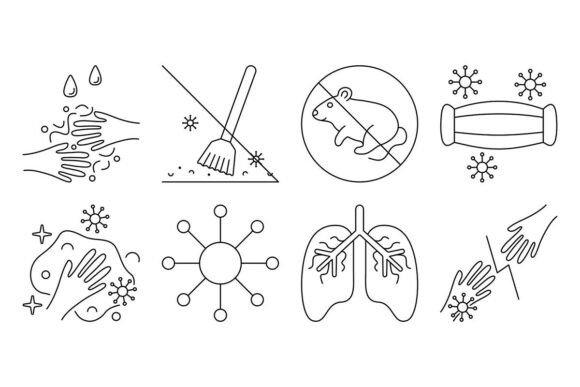
Hantavirus Black Line Vector Icon Set
Public health communication relies on clarity, speed, and visual consistency—especially when conveying urgent or complex biomedical information. The Hantavirus Black Line Vector Icon Set meets that need with a focused, purpose-built collection of monochrome linear symbols designed specifically for awareness, education, and prevention contexts. Unlike generic medical icon libraries, this set centers on the epidemiology, transmission pathways, and preventive actions tied to hantavirus—a zoonotic pathogen primarily carried by rodents and transmitted through aerosolized excreta. Its value lies not in aesthetic novelty, but in functional precision: every icon is editable, scalable, and built to integrate seamlessly into real-world health materials without visual compromise.
Designed for Purpose, Not Decoration
This isn’t a decorative vector pack. Each symbol in the Hantavirus Black Line Vector Icon Set reflects a documented public health concept: rodent reservoirs (e.g., deer mice, cotton rats), respiratory exposure routes, protective equipment (N95 respirators, gloves), sanitation practices (sealed food storage, rodent-proofing), and environmental risk indicators (dusty barns, abandoned cabins, nesting materials). The icons are strictly linear—clean strokes, no fills, no gradients—and intentionally minimal. That restraint supports legibility at small sizes (e.g., on laminated field cards or mobile infographics) and ensures compatibility with high-contrast accessibility standards.
The editable stroke property is a practical differentiator. Designers can adjust weight, dash patterns, or corner radius without distorting proportions—critical when adapting icons for print posters versus digital dashboards or translating them into tactile formats for low-vision audiences. All files are delivered in native vector formats (AI, EPS, SVG), preserving scalability and editing fidelity across platforms and team workflows.
Consistency Without Compromise
Icon sets often sacrifice coherence for variety. This one avoids that pitfall. Stroke width, terminal style (butt vs. round), spacing between elements, and proportional relationships remain uniform across 60+ symbols—from a simple “rodent silhouette” to layered compositions like “aerosolized virus particles near a disturbed nest.” That consistency reduces cognitive load for viewers: once a user recognizes the visual language (e.g., dotted lines indicating airborne dispersal), they apply that logic across related icons. In educational posters or multilingual safety guides, that predictability strengthens message retention more than stylistic flair ever could.
Quality control is evident in subtle details: the respiratory protection icon correctly positions the respirator strap behind the head—not over the ears—aligning with CDC guidance; the “seal entry points” symbol uses unbroken lines to imply structural integrity, not just suggestion. These aren’t assumptions—they’re evidence-informed design decisions grounded in occupational health practice.
Where It Fits—and Where It Doesn’t
The Hantavirus Black Line Vector Icon Set excels in projects where accuracy, adaptability, and regulatory alignment matter. Health educators developing bilingual outbreak response toolkits for rural clinics benefit from its clarity and localization-ready structure. Industrial hygienists building site-specific rodent mitigation checklists rely on its precise representation of PPE and environmental controls. Public health communicators designing social media assets for wildfire recovery zones use its clean lines to ensure readability on low-bandwidth devices.
It’s less suited for consumer-facing branding (e.g., wellness app interfaces) or illustrative storytelling that demands expressive texture or color nuance. There’s no anthropomorphism, no symbolic abstraction—just direct, unambiguous visual shorthand. That’s intentional. When communicating about a virus with up to 40% fatality in some forms (e.g., HPS), ambiguity is a liability, not a creative choice.
Real-World Usability in Action
- Educational posters: A county health department used the “rodent nesting + caution triangle” combo in a Spanish/English poster distributed to farmworker housing units. Field staff reported faster comprehension during briefings compared to text-heavy PDFs.
- Safety training decks: An OSHA-aligned construction safety course embedded editable icons into interactive PDFs—allowing trainers to highlight specific hazards (e.g., sweeping dusty crawlspaces) by adjusting stroke weight dynamically during live demos.
- Infographic development: A CDC-funded nonprofit streamlined their hantavirus risk map series by applying consistent iconography across regional data layers—reducing design time by ~30% while improving cross-state visual comparability.
Practical Integration Considerations
Because all icons share the same coordinate origin and bounding box conventions, developers can script batch imports into Figma or Adobe XD libraries—ensuring version control and reducing asset misalignment. For teams using design systems, the set integrates cleanly with existing typography scales: stroke weights align with common UI font weights (e.g., 1.5 pt ≈ semibold body text), supporting harmonious hierarchy in mixed-media layouts.
Hygiene and prevention concepts are represented with equal emphasis—not as afterthoughts, but as core components. Icons for handwashing technique, sealed trash disposal, and ventilation protocols appear alongside transmission vectors, reinforcing that prevention is behavioral and environmental—not just clinical. That balance reflects current WHO and ECDC frameworks, making the set useful beyond U.S.-centric contexts.
Limits and Realistic Expectations
No icon set replaces expert guidance or contextual adaptation. The Hantavirus Black Line Vector Icon Set doesn’t include region-specific rodent species outside North America or Latin America (e.g., no Bandicota for Southeast Asia), nor does it cover diagnostic lab workflows or clinical symptom progression. It’s also not animated or interactive out-of-the-box—those features require additional development effort.
Its strength is in what it *does* cover well: the upstream, community-level interventions that prevent exposure before infection occurs. If your project centers on post-exposure care, molecular diagnostics, or vaccine development, this set won’t serve as a primary resource—but it remains valuable for accompanying public-facing prevention messaging within those broader initiatives.
Who Benefits Most—and Why
Professionals who regularly translate technical health content into actionable visuals will find immediate utility: instructional designers building OSHA-compliant e-learning modules, public health writers developing CDC grant deliverables, or freelance creatives producing materials for NGOs operating in endemic regions. Small business owners managing agricultural operations, outdoor recreation facilities, or pest control services also benefit—using the icons to standardize internal safety signage without licensing fees or legal ambiguity around medical imagery.
For educators, the set supports scaffolded learning: start with the “rodent + virus particle” icon to introduce transmission, then layer in “respirator + ventilation” icons to explore mitigation. That modularity works across age groups—from vocational trainees to undergraduate public health students—without requiring redesign.
In sum, the Hantavirus Black Line Vector Icon Set delivers measurable efficiency gains where precision matters most: when lives depend on rapid, unambiguous understanding of risk and response. It’s not flashy. It doesn’t try to be. But in health communication—where clarity saves time, builds trust, and prevents harm—that’s exactly the point.