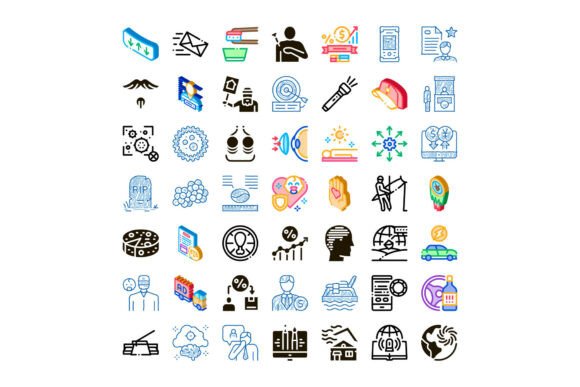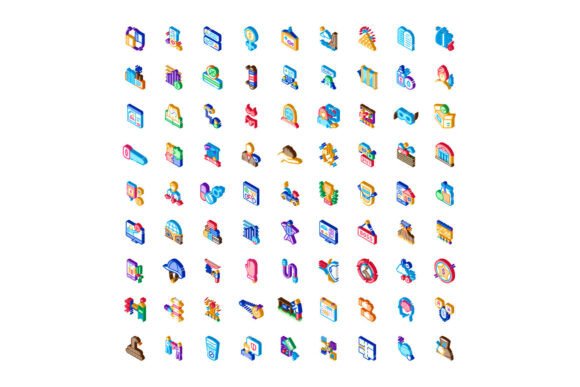
Isometric Icon Collection Business & T
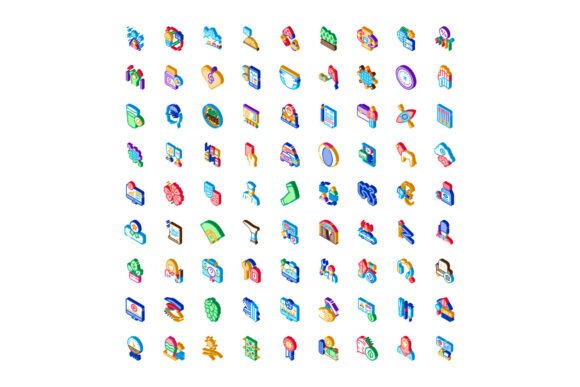
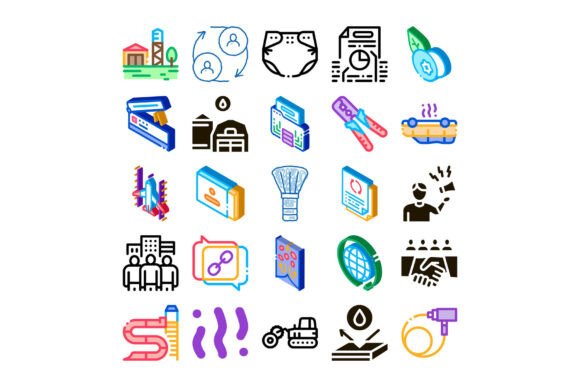
Imagine building a clean, modern dashboard—and instead of hunting for mismatched icons or paying for dozens of separate assets, you open one cohesive set: Isometric Icon Collection Business and T. It’s not just another icon pack. It’s a thoughtfully organized library of isometric-style icons covering business operations, tech tools, social interactions, and everyday moments—all designed to work together visually and functionally.
What Makes This Collection Different?
Isometric icons use a 3D-like perspective (typically 30° angles) while staying flat and scalable—no shading, no gradients, just clear geometry and consistent depth. Unlike generic flat or line icons, isometric ones add subtle dimension without sacrificing clarity or loading speed. The Isometric Icon Collection Business and T takes that principle further: every icon shares the same grid alignment, stroke weight, corner radius, and visual language. Whether it’s a “cloud server,” “team meeting,” “online shopping cart,” or “morning coffee break,” they feel like parts of the same world—not random clipart.
Designed for Real-World Use, Not Just Aesthetics
This collection shines where context matters most: explaining processes, guiding users, or visualizing data. Because isometric icons suggest spatial relationships and action, they’re especially effective in infographics showing workflows (“client onboarding → internal review → launch”), web dashboards with status indicators (“active user,” “pending approval,” “data sync”), or educational slides illustrating digital literacy concepts (“phishing email,” “two-factor authentication,” “cloud backup”).
Who Benefits—and Why?
Freelancers designing client websites appreciate how quickly they can mock up a SaaS landing page using matching isometric icons for features like “real-time analytics,” “API integration,” or “mobile notifications.” Small business owners building their first Shopify store use them to clarify product benefits—say, pairing “eco-friendly packaging” with a reusable box icon, or “24/7 support” with a headset-and-globe combo. Educators creating remote learning materials find these icons help students grasp abstract ideas faster—like showing “digital citizenship” as a person holding a shield over a connected device.
Even hobbyists and bloggers benefit. A personal finance blogger might illustrate budget categories (“groceries,” “transport,” “subscription services”) with friendly, recognizable isometric icons—making complex spreadsheets feel more approachable. A content creator building a Notion workspace uses them to label databases: “project pipeline,” “content calendar,” “feedback tracker.” No design degree required—just good visual hierarchy and consistency.
Where You’ll Use These Icons Every Day
- Web & App Interfaces: Buttons, navigation menus, empty-state illustrations, and feature cards all gain polish and clarity with isometric visuals that guide attention without overwhelming.
- Infographics & Reports: When explaining metrics (“customer churn rate,” “conversion funnel,” “team bandwidth”), isometric icons act as visual anchors—helping readers scan and retain information more effectively than text alone.
- Presentation Slides: Whether pitching to investors or training new hires, icons replace bullet points with intuitive, memorable imagery—especially useful when presenting across language barriers.
- Social Media Graphics: Instagram carousels, LinkedIn banners, and Twitter threads become more engaging when key ideas are reinforced with cohesive, on-brand icons.
- Print & PDFs: From pitch decks to workshop handouts, vector-based isometric icons scale flawlessly—no pixelation, no licensing surprises.
Practical Things to Keep in Mind
Before downloading or purchasing any icon set—including Isometric Icon Collection Business and T—check a few basics. First, confirm file formats: SVG is ideal for web use (lightweight, responsive, editable), while EPS or AI files suit print or advanced editing. PNGs with transparent backgrounds work well for quick drag-and-drop, but lack scalability.
Second, consider licensing. Most reputable collections offer commercial use rights—but always verify whether attribution is required, whether you can modify icons (e.g., recolor or combine elements), and whether redistribution (like including them in a template you sell) is allowed. The Isometric Icon Collection Business and T typically includes a straightforward license for personal and commercial projects—no hidden limits for freelancers or small teams.
Third, think about customization. Isometric icons rely heavily on consistent proportions and angles. If you plan to tweak colors or layer icons, make sure the source files preserve grouping and alignment. Some sets include color variants or dark-mode versions out of the box—handy if your project spans light and dark interfaces.
Getting Started Doesn’t Require Design Expertise
You don’t need Figma mastery or Illustrator fluency to begin. Many users start by browsing the collection’s category folders—“Business Tools,” “Digital Life,” “Social Engagement,” “Everyday Routines”—and dragging a few icons into a Canva presentation or Google Slides deck. Try pairing three related icons to explain a simple concept: “idea → prototype → launch.” Or build a visual checklist for a blog post: “research → outline → draft → edit → publish.” Consistency builds trust—even small touches signal professionalism.
As you grow more familiar, experiment with combinations: overlay a “notification bell” icon on a “dashboard” base shape, or place a “video call” icon inside a rounded “team circle” to imply collaboration. Because all icons share the same perspective and scale, these integrations feel intentional—not patched together.
A Thoughtful Tool, Not Just Another Download
At its core, Isometric Icon Collection Business and T supports clarity, connection, and confidence—not just decoration. It helps communicators say more with less. It helps creators ship faster without compromising quality. And it helps learners and audiences understand faster, remember longer, and engage more deeply.
That’s why so many turn to it—not as a shortcut, but as a smart foundation. Whether you’re sketching a wireframe before coding, preparing a workshop for local entrepreneurs, or building your first online course, having a reliable, versatile set of isometric icons means one less thing to overthink—and more energy to focus on what truly matters: your message, your audience, and your goals.